
Plant, Animal, and Wildlife, Genetic Resources for Food and Agriculture Secured in either medium or long-term conservation Facilities
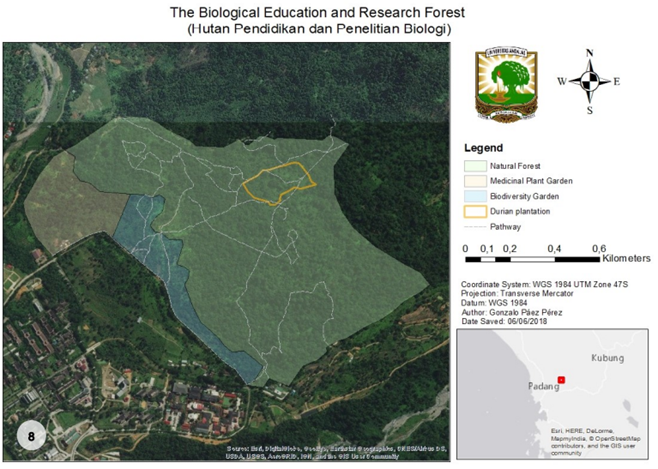
The Biological Education and Research Forest (HPPB) of Universitas Andalas represents one of the most ecologically significant conservation areas within the Limau Manis Campus. This lowland tropical secondary forest supports a remarkably high diversity of flora and fauna, including numerous endemic and protected species native to Sumatra. The HPPB serves not only as a site for biodiversity conservation but also as a living laboratory that supports research, education, and ecological awareness for both students and researchers.
Recent ecological studies conducted in the area have revealed an estimated 530 tree species, with dominant families including Euphorbiaceae, Moraceae, Fagaceae, and Lauraceae. Many of these plant species are fruit-bearing, providing essential food resources for frugivorous wildlife. In addition, surveys coordinated by the Andalas University Herbarium (ANDA) have documented 21 species of gingers (Zingiberaceae), 25 species of epiphytic ferns, 165 tree species, and 34 species of wild orchids, along with numerous other taxa. This rich vegetation supports a complex ecosystem that sustains an equally diverse animal community.
The forest is also home to a wide variety of fauna. Recorded species include 5 termite species, 30 ant species, 21 spider species, 23 dragonfly species, 51 butterfly species, 18 amphibians, 8 snake species, 160 bird species, and at least 100 mammal species. Notably, several endangered and endemic primates inhabit the area, such as the Agile Gibbon (Hylobates agilis) which is endemic to Sumatra and the Malay Peninsula, and the Sumatran Surili or Mitred Leaf Monkey (Presbytis melalophos), both of which are commonly observed in high densities along the forest trails. Other frequently seen primates include the Long-tailed Macaque (Macaca fascicularis), the Pig-tailed Macaque (Macaca nemestrina), and the Siamang (Symphalangus syndactylus), particularly in the northern section of the HPPB.
Beyond primates, the forest harbors a healthy population of wild boar (Sus scrofa), and sightings of rare species such as the Malayan Tapir (Tapirus indicus), the Sumatran Sun Bear (Helarctos malayanus), the Black Giant Squirrel (Ratufa bicolor), and the Sunda Flying Lemur (Galeopterus variegatus) have been reported, highlighting the ecological importance of this protected habitat.
In addition to native species, HPPB is home to several exotic and notable flora, including Dipterocarps (Dipterocarpus spp., Hopea beccariana, Shorea spp.), Oaks (Castanopsis costata, Quercus oidocarpa, Lithocarpus meijeri), members of the Rafflesiaceae family such as Rafflesia, and pitcher plants (Nepenthes ampullaria, N. mirabilis, N. gracilis). Among its exotic fauna are the Slow Loris (Nycticebus coucang), the Sumatran Tiger (Panthera tigris sumatrae), the Lesser Mouse-Deer (Tragulus javanicus), and the Red Muntjac (Muntiacus muntjak), which further emphasize the area’s vital role in regional biodiversity conservation.
Overall, the HPPB exemplifies Universitas Andalas’s strong commitment to biodiversity protection and sustainable ecosystem management. It stands as a living example of how academic research, education, and conservation can be harmoniously integrated within a university campus setting.
Additional evidence link (i.e., for videos, more images, or other files that are not included in this file):
http://repo.unand.ac.id/14685/1/Profil%20HPPB%2002062018%20V-6%20Cetak.pdf